

Press
The Wire – Four contemporary industrial projects serve up ugly music for an ugly world
By Joseph Stannard, Issue 496, June 2025,
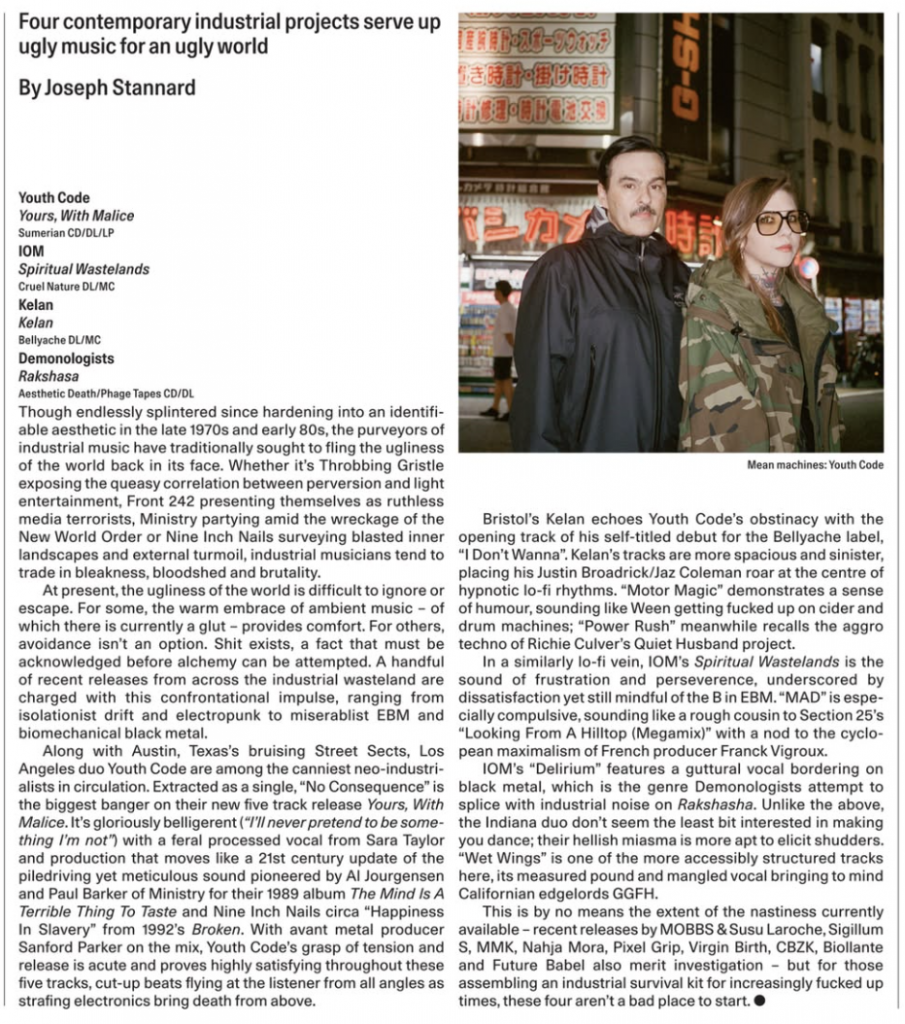
https://www.thewire.co.uk/issues/496
Youth Code – Yours, With Malice – Sumerian CD/DL/LP
IOM – Spiritual Wastelands – Cruel Nature DL/MC
Kelan – Kelan – Bellyache DL/MC
Demonologists – Rakshasa – Aesthetic Death/Phage Tapes CD/DL
Though endlessly splintered since hardening into an identifi-able aesthetic in the late 1970s and early 80s, the purveyors of industrial music have traditionally sought to fling the ugliness of the world back in its face. Whether it’s Throbbing Gristle exposing the queasy correlation between perversion and light entertainment, Front 242 presenting themselves as ruthless media terrorists, Ministry partying amid the wreckage of the New World Order or Nine Inch Nails surveying blasted inner landscapes and external turmoil, industrial musicians tend to trade in bleakness, bloodshed and brutality.
At present, the ugliness of the world is difficult to ignore or escape. For some, the warm embrace of ambient music of which there is currently a glut – provides comfort. For others, avoidance isn’t an option. Shit exists, a fact that must be acknowledged before alchemy can be attempted. A handful of recent releases from across the industrial wasteland are charged with this confrontational impulse, ranging from isolationist drift and electropunk to miserablist EBM and biomechanical black metal.
Along with Austin, Texas’s bruising Street Sects, Los Angeles duo Youth Code are among the canniest neo-industri-alists in circulation. Extracted as a single, “No Consequence” is the biggest banger on their new five track release Yours, With Malice. It’s gloriously belligerent (“I’ll never pretend to be some-thing I’m not”) with a feral processed vocal from Sara Taylor and production that moves like a 21st century update of the piledriving yet meticulous sound pioneered by Al Jourgensen and Paul Barker of Ministry for their 1989 album The Mind Is A Terrible Thing To Taste and Nine Inch Nails circa “Happiness In Slavery” from 1992’s Broken. With avant metal producer Sanford Parker on the mix, Youth Code’s grasp of tension and release is acute and proves highly satisfying throughout these five tracks, cut-up beats flying at the listener from all angles as strafing electronics bring death from above.
Bristol’s Kelan echoes Youth Code’s obstinacy with the opening track of his self-titled debut for the Bellyache label, “I Don’t Wanna”. Kelan’s tracks are more spacious and sinister, placing his Justin Broadrick/Jaz Coleman roar at the centre of hypnotic lo-fi rhythms. “Motor Magic” demonstrates a sense of humour, sounding like Ween getting fucked up on cider and drum machines; “Power Rush” meanwhile recalls the aggro techno of Richie Culver’s Quiet Husband project.
In a similarly lo-fi vein, IOM’s Spiritual Wastelands is the sound of frustration and perseverence, underscored by dissatisfaction yet still mindful of the B in EBM. “MAD” is espe-cially compulsive, sounding like a rough cousin to Section 25’s “Looking From A Hilltop (Megamix)” with a nod to the cyclo-pean maximalism of French producer Franck Vigroux.
IOM’s “Delirium” features a guttural vocal bordering on black metal, which is the genre Demonologists attempt to splice with industrial noise on Rakshasha. Unlike the above, the Indiana duo don’t seem the least bit interested in making you dance; their hellish miasma is more apt to elicit shudders. “Wet Wings” is one of the more accessibly structured tracks here, its measured pound and mangled vocal bringing to mind Californian edgelords GGFH.
This is by no means the extent of the nastiness currently available-recent releases by MOBBS & Susu Laroche, Sigillum S, MMK, Nahja Mora, Pixel Grip, Virgin Birth, CBZK, Biollante and Future Babel also merit investigation but for those assembling an industrial survival kit for increasingly fucked up times, these four aren’t a bad place to start.
The Quietus – New Weird Britain In Review For February By Noel Gardner, February 2021
https://thequietus.com/quietus-reviews/new-weird-britain/rachel-musson-luke-haines-pirate-radio
Spanish musician IOM, or Iker Ormazabal Martínez, is an artist again trapped in London, but he can (and does) sell his effects pedals from home, so don’t cry for him too much. “Several” of those pedals are used on his latest release, a tape on Barcelona label Hedonic Reversal titled Izkuturik Ziren Hitzak Eztabaiden Artean Aurkitu Ditut, Baino Soinurik Ez Dute Egiten – Basque for “I found invisible words amidst the arguments, but these words wouldn’t make any sound”. Although this set of piston-powered industrial meets proto-techno seems to be a new angle for Martínez, I’m kicking myself for being late to his party, especially given his last release The Oscillation came out on Cruel Nature (right before Sarcastic Burn Victim, indeed) and he’s played in clangy rock experimenters Warren Schoenbright.
Sporting a neato concept relating to time, Izkuturik’s eleven tracks were all recorded in one take and encompass Techno Animal-ish doom dub (‘Indumentaria De Gilipollas’, ‘Bruite’), off-centre production line clank like, say, Run Dust, or Richard H Kirk with hardcore kicks (everything from ‘Emma Goldman Sachs’, another for this month’s list of gently amusing titles, through to ‘Garaiak’ pretty much), and JCB-sized scoops of bass over metal-hard frameworks, the sort of goodness Hessle were putting out a decade ago (‘Bigarren Zortziko’). No clue if Martínez plans to make more stuff in this vein and/or under the IOM moniker, but I’d welcome it.
Bandcamp Daily – The Tape Label Report, Unlimited Dream Company album review, July 2023
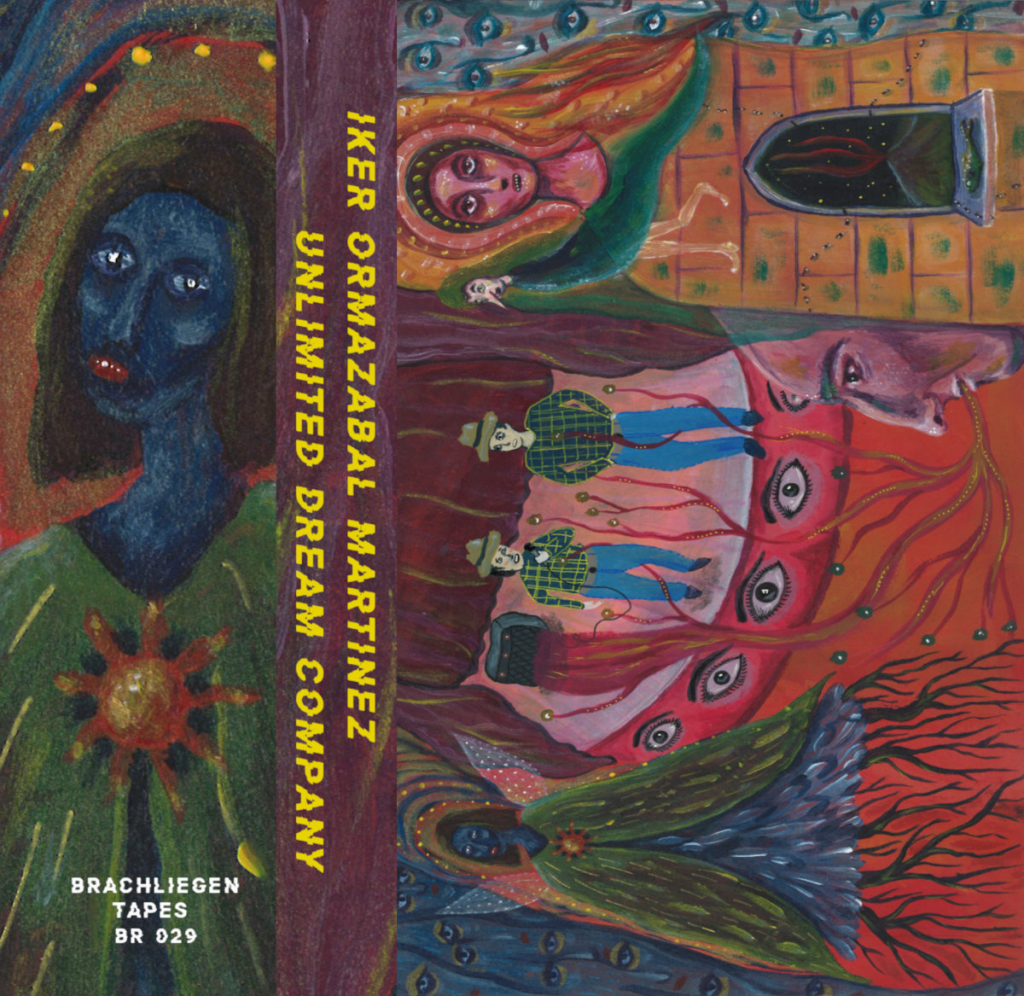
Perfectly encapsulating Brachliegen’s approach is Iker Ormazabal Martínez’s second outing for the label. Unlimited Dream Company is a juddering, mechanical throb, constructed from rhythmic belters forged as if by clubbing white hot metal lances across an anvil. His gravelly, guttural intonations rasp threateningly over searing drones, bit-crushed synths, and caustic, whipped beats. This is IOM’s assault on the baked-in sensibilities of apathetic Middle England, lighting a furnace beneath their cozy ideologies and recalibrating their weak moral compasses. His industrial noise may be politically fueled, but its gait and groove will rip chunks out of any dance floor bold enough to accommodate it.
Yeah I Know It Sucks – Nothing album review, 2019

https://yeahiknowitsucks.wordpress.com/2019/05/29/iom-nothing/
You want to experience joy? Why not become evil! “Nothing” might cater to the nihilistic people out there, but as a full blown person that isn’t one of them, I can gladly report to you that this might as well be well worth a listen if you are into the opposite of nihilism. I mean there might be a gigantic chance that the music over here would simply dig it’s way in, that in the end your fruitful hopeful look on life simply gets annihilated & you will become the unemphatic nihilist that you might have avoided at all times yourself. A strange transformation that would probably transfer beautiful coloured butterflies straight back into grey looking psychopathic caterpillars,
The music isn’t nice, never trying to be. It’s there to dig around in the hot hate with an certain ice coolness over it that feels like it could burn down entire cities. The vocals in here are giving me the ultimate shimmers; they are punk as hell and very meaningful, it’s as if they scream out the pain that you feel somewhere deep within your system, expressing thoughts that you might never have guessed that they had been hiding in there, but so painfully expressed that you know it’s a true relief to hear them expressed under the annihilating sound of big banging powerful industrialism of the most unforgiving frightening kind. In here lays the power, as who doesn’t love the banging bangs, the loveless industry of machines beating the shit out of beauty as we know it? It’s better than chopping down trees or blatantly stepping upon new born flowers in the back yard; but it’s just as satisfying.
It’s as if you had joined the bad people, the evil doers in the movies, the dark lords in a dystopian future in which all free thinkers are locked up and chained up to work in a coal mine of some sort. Hard labour will be their future, as we accept to roam freely in the bleakness of feeling no mercy, nothing but nothingness for them or any life on the planet. The music just burns everything up and you know what? The dark expressive soulless expression is bloody well perfect! The power to be one with the villains is stronger than the one of becoming a holy saint for good and in the end rocking out as the cynical nihilist that we all will become will give us nothing but stale cold hearted energy to overthrow powers of good, mash everything up and take shit from absolutely no one! It feels Freaking great to be evil!
Monolith Cocktail – Spiritual Wastelands album review, March 2025
https://monolithcocktail.com/2025/04/25/the-digest-for-april-2025-new-music-the-social-playlist/
Circulating, pulsing and dancing through the magnetic circuits of the inner body and mind, caught up in the chaotic stresses and violence of our current times, the latest album from the Spanish musician and sound designer Iker Ormazabal Martinez is powered by a caustic electricity and metallic industrial percussive tools.
Under the soloist guise of IOM, Martinez wields his EBM and industrial synth-techno influences to beat out and charge up a physical sonic response to modern existence. Wretched, sometimes near violent, but always with structure and rhythm, the nine concomitant pieces that make up the thematic whole of Spiritual Wastelands move between the darker club music of the German underground and the alien factories of dead industry.
From Basque country Vitoria to Catalonia Barcelona and a relocation in recent years to London, the granular guide of frazzled and force field gated electronica has merged his experiences as a keyboardist and sample-instigator for pop and rock groups, a musician with a company of Butoh dancers (originally a Japanese “dance of utter darkness” in which performers, usually covered in white paint makeup, intentionally use slow body movements and confront themes of darkness and transformation, but also far more radical and taboo subjects), and experimental electronic artist to create a vaporising density of tubular, barracking sheet metal dance music. Through the distress and clang of the pipes, the fizzled and machine reverberated, glimpses of trance-y light are found, and on the mystical voiced ‘Light’, featuring The Seer no less, there’s an obscured hint of Middle Eastern horns and a shrouded spiral of the Sufi against a darker churn of laboured drones and resonating steel.
Vocals sound near Germanic, or of that school, or go deep and near sinister; reminding me in part of Front 242 and NIN but put against sounds and rhythms and beats that err towards Basic Channel, Pan Sonic, Cabaret Voltaire and CABLE. The futuristic computerised and iterated saw brushed ‘Somatic Response’, sounds almost Kraftwerkian in comparison: perhaps a little Kriedler.
Mind and body yearning for spiritual guidance or a way out, react to the modern furnace on an album full of oomph and fried electricity. Does After releasing a variety of works on a myriad of labels, IOM finds the perfect pitch with Cruel Nature ever seldom put out an uninteresting or intriguing album.
Industrial Complexx Magazine – Spiritual Wastelands Review, March 2025
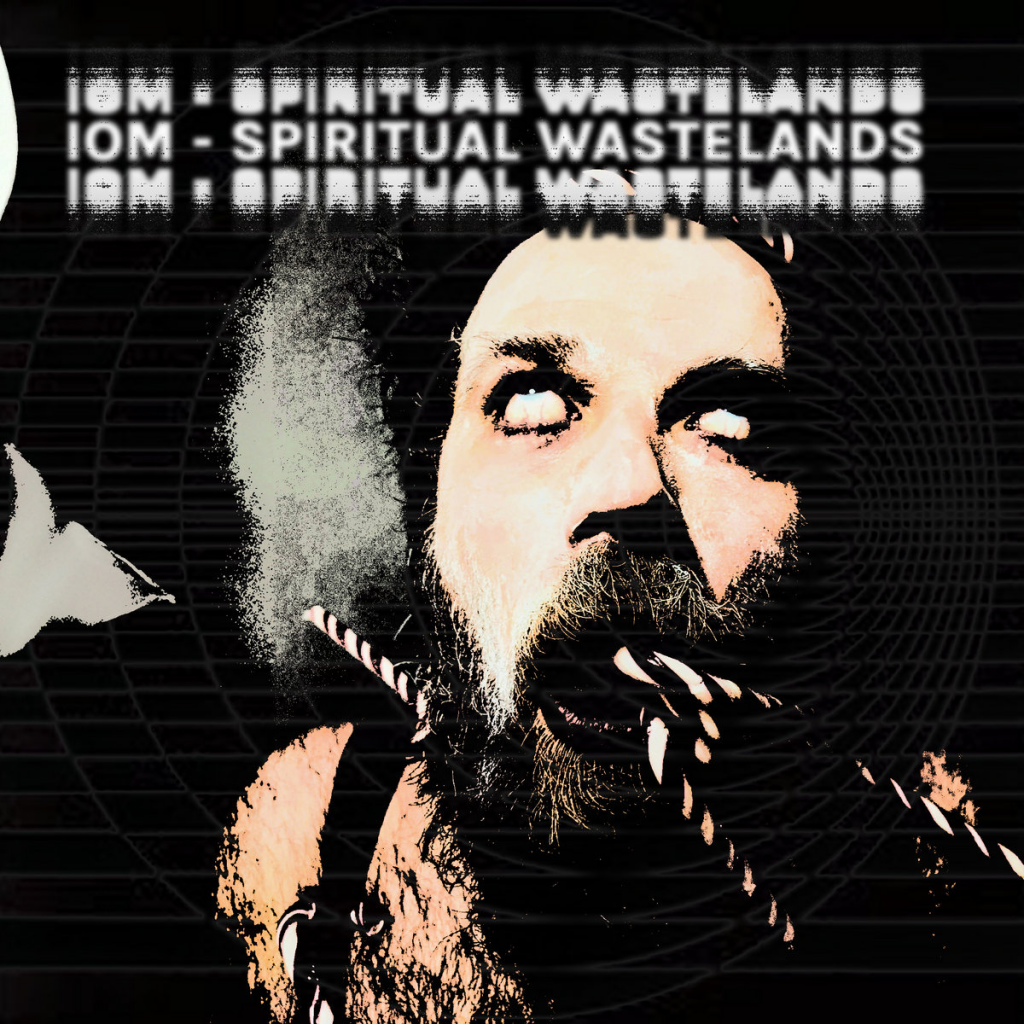
https://industrialcomplexx.com/iom-spiritual-wastelands-cruel-nature-records/
Spiritual Wastelands, the latest work by IOM, the solo project of Iker Ormazabal, immerses the listener in a desolate soundscape where distortion and rhythmic drive become metaphors for a fractured world, both physically and emotionally. This album reflects on the human condition in the modern era, exploring themes such as abandonment, resistance, and the search for meaning amidst chaos.
Iker Ormazabal, with a career spanning pop, rock, experimental music, and audiovisual design, demonstrates in Spiritual Wastelands an artistic maturity that transcends genres. Here, 90s EBM acts as the backbone, with pounding rhythms and hypnotic basslines reminiscent of pioneers like Front Line Assembly or Esplendor Geométrico. However, IOM doesn’t just recreate a classic sound; he reinvents it, distorts it, and takes it to new territory, where the experimental and the personal merge masterfully.
One of the album’s greatest strengths is its ability to build a coherent narrative. Each track is a fragment of a whole, a piece of a puzzle that speaks of desolation but also of hope. The production is impeccable, with layers of sound overlapping and colliding, creating rich and complex textures. Distortion is not just an effect but an expressive tool that conveys the fragility and tension of the themes explored.
Compared to his previous work, Unlimited Dream Company, where IOM used industrial noise to confront cultural hegemony and social fractures, Spiritual Wastelands delves into a more personal introspection. Here, abandonment is not only physical but also spiritual, and regeneration is presented as a possibility, though never without pain. The album is, in essence, a meditation on human resilience.
The melodic aspect, though not the focus of the project, appears at key moments, adding contrast and emotional depth. Tracks that might evoke Front Line Assembly in their more melodic facet, or Esplendor Geométrico in their more rhythmic vein, demonstrate IOM’s versatility as a composer. However, what truly stands out is how Ormazabal manages to make these influences sound fresh and current, thanks to his innovative approach to production and his ability to blend analog and digital elements.
Side-Line Magazine – Spiritual Wastelands Review, June 2025
https://www.side-line.com/iom-spiritual-wastelands-digital-album-cassette-cruel-nature-records
IOM stands for Iker Ormazabal Martínez, a Spanish artist who operates from London (UK). He has already produced a significant body of work and has participated in numerous collaborations.
“Spiritual Wastelands” is a fascinating album where the artist explores different genres, primarily falling under the Industrial-Electro category. He creates an extremely dark atmosphere that becomes quite grim through Industrial noises and effects. Icy electro sounds reinforce the overall mood. Most of the tracks are instrumentals but none of which sound disturbing or monotonous. However, you will also find rare passages featuring spoken Spanish words and even a kind of Eastern-inspired singing in the opening piece.
“Spiritual Wastelands” is a magical and somewhat visionary Industrial record that I can only recommend to you. (Rating:8½).
Luminous Dash Musiek Zine – Spiritual Wastelands Review, April 2025
https://luminousdash.be/reviews/iom-spiritual-wastelands-cruel-nature-no-sides/
Iker Ormazabal Martinez, afgekort dus gewoon IOM, werd geboren in Vitoria, Spanje maar woont al enkele jaren in Londen. Sinds 2004 bestookt hij de wereld met zijn experimentele elektronica en dat onder een veelheid aan namen. IOM en zijn eigen naam zijn maar een paar van de vehikels waarin hij zijn creativiteit kwijt kan.
Mnemoniic, Warren Schoenbright, Sorkun en Atamoog zijn er daar enkele van. Hij werkte eerder ook samen met artiesten als Gonzalo Catalinas, Raxil4 en Jordi Aligué. Tevens maakte hij de soundtrack voor de film Elementary Tryptych of Spain van de regisseur Jose Val del Omar, waarmee hij overigens een prijs won.
Effectpedaaltje nodig? Dat kan bij zijn bedrijf IOHM Fx. Muziek nodig bij een dansvoorstelling? Iemand nodig om me te improviseren? Voor een avondje met de beentjes gooien in een wild dansfeest? Hij kan en doet het allemaal. Zijn releases verschijnen op een waaier aan labels en dan moet het een keer lukken dat we iets van zijn werk te horen krijgen natuurlijk. Bij deze dus, en het bevalt ons nog ook. Liefhebbers van EBM, bands als Front Line Assembly en Esplendor Geométrico of avontuurlijke luisteraars die hun elektronica graag divers, veelzijdig, geïnspireerd, speels en ietwat dansbaar hebben zullen met Spiritual Wastelands zeker uit de voeten kunnen.
Zo nu en dan gebruikt Martinez zijn stem, wat deze nummers een nog duidelijkere EBM-stempel geeft. Noise ook hier en aar, schrapende binnen zijn klankenwereld, die raspende diepe stem die in het Spaanse broebelt, het heeft allemaal net dat beetje mysterie die ervoor zorgen dat we dit album moeilijk kunnen vatten en/of beschrijven, waardoor we het maar blijven opzetten. Het is een trucje als een ander om de aandacht vast te houden.
Louder Than War – IOM: Spiritual Wastelands album Review & Interview By Ryan Walker, March 2025
https://louderthanwar.com/iom-spiritual-wasteland-album-review-interview/
As IOM, the new album from Iker Ormazabal Martinez on Cruel Nature Records, Spiritual Wastelands refuses to censor the view that some people are afraid to acknowledge as more than just a disconcerting vision, whilst others pray that its existence is a nothing but factual. Review and Interview by Ryan Walker.
What happens in the Spiritual Wasteland? Who, or what, ends up there? What have they done to deserve being condemned to such a landscape?
Ask Iker Ormazabal Martinez.
Approximating to The Swamps of Sadness in Fantastica from Michael Ende’s novel The Neverending Story, the wind-racked surfaces of LV-426 or Dali’s Persistence of Memory, The Spiritual Wastelands is a refuge for scum. A shore of residue. The eternal endpoint, despite which direction the wooden signpost arrows convince us leads to some sort of retribution. It leads nowhere. We wake up, try to wipe the dirt away from our eyes, and before a shudder suddenly snaps out of a freeze of incredulity, run towards the hills, naked and feral. ”The spiritual wastelands are a collective space, like a dumping ground for all the moral and spiritual trash of our modern society. It’s where all the hypocritical values and ideals pushed by capitalism, politicians, religious leaders end up, along with all the damage caused by our personal and work relationships,” says Iker. ”We don’t have a communal space to deal with this spiritual and moral garbage.”
Providing an ontological soundtrack for this ruin called Spiritual Wastelands, the ferocity new album by IOM on Cruel Nature is drawn from an admittance that, whilst silenced under the shadows of our deepest fantasies and stalked down the paranoid corridors of our private terrors, wrapped in a mesh of hegemonic tentacles that stretch and elongate from one system of power to another, suction cups sucking off any sense of individual distinction and sparing it no mercy- there is no collective site to convoke or confide the damage that has been done by this prolonged, everlasting grind.
In turn, this only feeds the Wasteland. Fattens it. It feasts on our seclusion. It becomes a hideous permutation of what we fail to find a moment safe enough to say what we mean (and not what we think we should mean), a forbidden rendition of republic exchange, and we are inevitably, eternally entangled in the biomechanical architecture of its splintered landscapes.
If such an opporunity existed, then the coping mechanisms to soothe the afflictions of apparatus that, either next to you in bed, in the stomach of a ballot box, or opposite the dining table, mince us into meat, wouldn’t lead such an extensive explosion of corrupted political forecasts, tyrannical stronghold, mindless moral panics, mental ill-health crises, interpersonal witch hunts, arrays of addictions, death, etc. In this way, the Spiritual Wasteland is a monolithic, metaphysical, metaphorical ‘reap what you sow’ resort, a mirror with no reflection, a moat castle with no entrance, or exit – we simply arrive once the vote has been cast. ”Psychology can be a personal space, but there aren’t many communal spaces where we can comfortably share these experiences,” Iker adds. ”Even with family and close friends, these topics are often taboo or off-limits. Religion, which could arguably have been a place for this kind of sharing, is also perverted and causes more harm than good.”
Like K.K. Null on Sweatbox, The Light feat. The Seer is a slowly prowling rumble of rhythmic noise. A throbbing brain fust-fucking its way through a pitiful village easier than Mr. Muscle through a clogged drainpipe. With the aching, ancient oak wood screams of the betwitching Seer, a deathbed of wild, maniacal cackles and chipped paint breaths and echoing into the air, creating an enchanting vortex through which we fall, inevitably a dancefloor dropped onto some kind of gruesome future. A simultaneous ballet (or battle) of sexy electronica and terrifying noise, No Quiero Ser is an analogue odyssey of industrial experimentation. Translated as ‘I don’t want to be’ – it’s a deformed, glitchy uprising of rotating beats, snapping apart amongst a regurgitated ceremony of an Arturia Minibrute oozing slime from their tight openings, teasing dismantlement at any given moment.
Iker relocated to Barcelona from the Basque Country in 2004. It was here that he fell into the small but still engaging experimental music scene. Miguel A. García, who passed away in January, was an influential exponent of and from, this scene who worked in the field sound art. ”He was one of those people who made things happen,” recalls Iker. ”When I moved to Barcelona, he put me in touch with C-utter, a band from Barcelona involved in Radio Bronka. They had a show called Fuck The Bastards where they would invite touring experimental artists to perform live. I became a member of the radio, and that created multiple connections with other collectives such as LEM, Ojalá Esté Mi Bici, Artilleria Pesada, Magia Roja… Before moving to London, I was also involved with one of those other collectives, Ojala Esté Mi Bici, and to this day, I try to visit them every year.
”I have made many good friends with common views about music. I like to share ideas with them, get feedback, and see each other play live… I do like to see well-established artists as well, but if I had to choose, I’d much prefer to have a friendly community around with opportunities to share things together. Larger gigs for me are often like watching a movie, it’s great, but the interaction is not bidirectional.”
Along with situating himself within this exprimental culture, making music is inbuilt in Iker’s daily routine. He never stops. The album’s concept was captured in this commonplace practice, only evolving and coming into focus as the number of tracks increases, and the pieces formulate in a congregation of something cohesive enough to look at, not just imagine looking through. ”I just keep recording things and normally there is a point where I have quite a few ideas and common themes start appearing, ”Iker explains. ”It is at that point where I start thinking about the concept and about linking things together to form a bigger picture. In this case, there have been a few past experiences with mental health issues that have given shape to the whole concept of the Spiritual Wastelands.”
Although hardly an obvious commitment to Electronic Body Music (a subculture prominent in the 80s and 90s, reductively noted for its techno-fuelled physicality, dance-orientated mechanical grooves and cyber-gothic moodiness), the pelvis-melting influence is pretty hot from start to finish. Harnessed to express and explore the narratives of abandonment and regrowth of Spiritual Wastelands. This tool is a tool used differently compared to the Unlimited Dream Company, a record that underpinned its monstrous energy via an oscillating surge of industrial noise, itself used as a tool to confront cultural hegemony and expose societal fractures. ”The style does help deliver the message, but the same message could be delivered through many different styles,” Iker explains. ”With my solo project, I have mainly been developing two areas: one of them very rhythm-based, which is the one on this album or Unlimited Dream Company and the other area is a bit more abstract and freeform, which can be heard on albums such as The Oscillation or Kronos Kairos. Between both aspects of the project, I feel like I can transmit most of my ideas across.’’
And although the album is loosely tied, stylistically to the tumping, steel-beating athleticism of the EBM scene in the 90s, rather than present some pastiche of Leæther Strip, Rhea’s Obsession or Code Industry records, Spiritual Wasteland’s ingenuity can be situated in how Iker flexes his muscles bond that appears to be deliberately broken and adopted as a useful tool, a suitable production vehicle to reinforce and carry the larger connotations of IOM’s worldview forwards. There’s too much to say, and in too many ways, to sacrifice his standards to the level of a disingenuous, subcultural stylist. ”To put it in a different way,” he adds, ”the styles are not part of the album concept, they have more to do with how I have developed my musical practice and production skills.”
Alongside the writhing, underground-club-smash-on-Wax-Trax-that-never-was guitar grind of Self-Governance, upping the industrial ante with plenty of frazzled, cyberpunk soundscapes and a supercharged, head-against-wall chorus, punching in between the moments where the coast is clear, the pelvis-melting dystopian industrial electro-dub tactics of Delirium and Terror epitomise the essence of EBM the most. The former emits a ferocious surge of hot, pulsating drones, machines with their own minds approximating Skinny Puppy remixed by The Bug covering Clock DVA. A frenzied gale of trains rattle past as though summoned up to suck us through a screw hole in the wall. The latter wraps an electric headset around our heads and casts us into a cloud of oblivion, breaking the dividing lines between reality and the alcoves of our unconscious. Distant animations of clamorous, clanging noises suggest spasms of lonely clockwork breaking below the pressure of what is expected to keep in permanent states of motion, creating a rhythm as they creak into shape. Distorted stabs and solar winds gorge on all the senses. Everything dissolves after the immense swell.
However, although there’s something tantalising inbuilt in EBM’s DNA that captures the vibe menacingly pulsating throughout Iker’s work, it’s far from a simple reference based on how many Absolute Body Control records Iker has in his collection. As on every album, the collected tracks reflect an experiment of documented evolution- an ongoing process, rather than a fixation with results. This isn’t to cheapen the body of work before us- for that is something Spiritual Wastelands indubitably encompasses, and most likely informed by cult industrial pioneers and cassette label luminaries Esplendor Geométrico more than Nitzer Ebb. ”When I make music, I try to think as little as possible and try to make it an intuitive process,” Iker says on his approach. ”The use of distortion on rhythm has always been one of my main areas of interest, and EG do it very well. For quite a few albums, I have been using a Sherman Filterbank to distort drum parts with envelope followers. I would think that is how they were processing drum machines in their early releases through the Korg MS-10, so there is that as well.”
But the technique of teasing elements of the tunes out of their hiding holes via a spell of earth-shaking noise is a principle that Iker has been into since 2019’s Nothing.
”I tend to build the tracks around the rhythm part and develop a sound for those parts. The textures and melodies that reference other things or styles are layered on top of that foundation, and I believe this is what keeps the whole [thing] a bit more personal.”
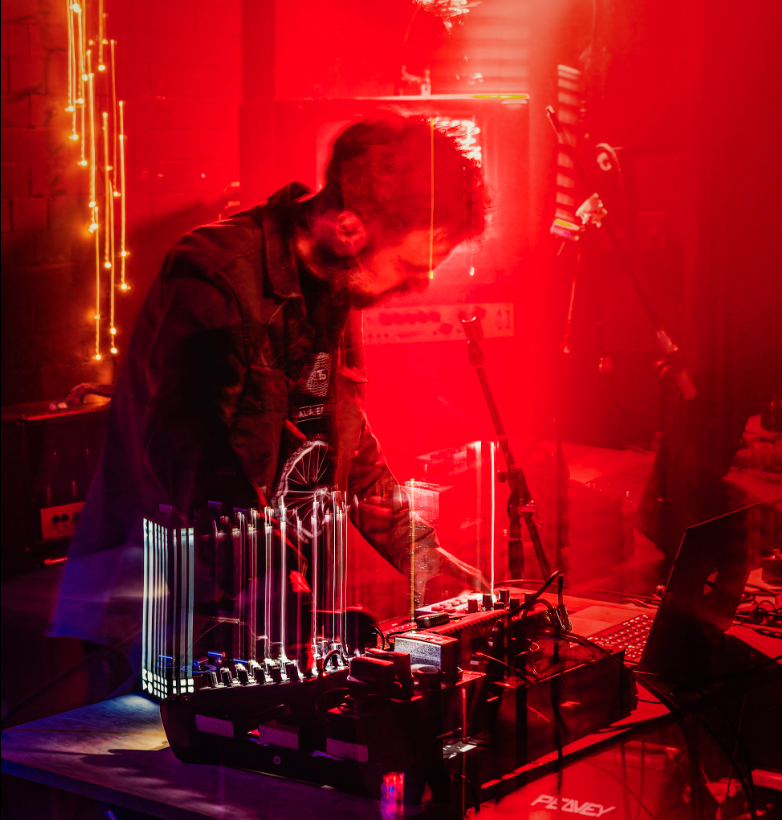
Thinking about the robust aural pyrotechnics deployed by Iker, paints on the palette, a rainstorm of irritated artillery shells and bone saw atmospherics growing a cyclone between the synapses; does he even see music’s function as a tool? ”It’s a difficult question,” he ponders, ”maybe more of a toolkit than a tool. Music can go so many different ways and can be shared in so many different situations: dancing in a club, in live music venues, listening to the radio or playing it back on personal devices, deep listening individually or collectively. I don’t think there is a single umbrella for all of them.”
Perhaps the medium isn’t the message after all. Spiritual Wastelands is an album that defines being categorised in any of the above dominant listening practices. It requires complete absorption as an experience- a frantic passage between REM and waking up in a bloody field, a muddy forest, to create a sense of foreboding, geographical arrangements that define its view: formations of fractured landscapes – both physical and mental, that define modern existence.
As a nation of tourists, as travellers, as the unfulfilled, yet refined origin of the grim, misshapen, calamitous ectoplasm that populates the Wasteland, we are swallowed by what we try to escape. We succumb to what we are afraid to discuss. Cocooned in a blanket of distractions. Unwilling to surpass the place where the ‘out of bounds’ warning is stabbed into an ancient mound, cutting a thin shadow across its vast emptiness. There is nothing to escape. Because escape is futile.
Delirium. Terror. Self-Governance. Words scribbled onto the walls that upkeep an underpass of crumbled brickwork in a hurried state of anarchy. The work of someone who has had enough of the suffering they have surrendered to with their lips permanently zipped up, forced to wear a wire and psychologically shoehorned into a fearful, snowglobes existence. Exposing religious hypocrisy, detonating political systems, cultural hegemonism, ideas of sacrifice and subjugation – the album is dystopian by design, as a lot, if not all, of Iker’s albums are. In their own nuanced way, Happiness and Sacrifice from 2022 (although Home Is Where The Hatred previously could also be included), Unlimited Dream Company a year later, and now Spiritual Wastelands form a bombastic, teeth-gnashing trilogy of albums that address a lot of hard-hitting issues.
”I guess that’s the closest to a political position I can get.’’ Iker supposes. ”As a society, we have internalised too much the idea of having external powers deciding for us. We assume that we are not able to tell apart good from bad except through an intermediary who is in touch with a higher power, or that we don’t have the self-power to evaluate our own actions. These are both an excuse to not be accountable for our own actions and a way into political subjugation.”
More Merzbow signed to Mute or Nocturnal Emissions on Metoplex than a gang of leather-clad titans in their aviators, a palpitating noise weaves itself throughout the album. An instrument altogether. A presence. Spiritual Wastelands is all filtered through Iker’s unique touch of blending experimental textures, production techniques using hand-made noise generators and oscillators, and a personal approach to composition that sees Iker experiment with ”different combinations of connecting the same devices,” to a mosaic of brutally sculpted yet boisterous results. This trinity spares the record from being a blatant, even benignly direct homage to history. This is nothing but forward-facing.
Despite its theme of regeneration in the backwoods of a civilisation gone mad, this is not meditative work, taking stock of what has happened. And despite the damage and the Wasteland up ahead, optimism rages from those sentiments of imprisonment. An exhausting hope that guides us through the murky abstraction of abandonment and isolation unto better, more restorative and therapeutic futures. ”Yes, that is the basic idea,” agrees Iker. ”I think we all find some common expressions in music that create collective experiences that are very positive and make us feel that we are not alone.”
From the grotesque, acid-dunked dirge of Body as Object, all tribal rhythms engraving themselves into a plank of glistening synths and M.A.D, a thick slice of corruscating keyboard action complete with fluttering drums and indomitable drive – gain and decay dials firmly fastened to the right, but possessing a magnetic swagger whereby one can imagine Iker manning the controls – dilated pupils, foaming at the mouth, unshaven for months, possessed by the hazardous jam of this cinematic backwards breakbeat; each song is a fragmented tangent, a part of the album’s overarching predilection of social overdrive, political meltdown, scandalous religious dogma, and the coping mechanisms we create to sterilise and blunt their consequential sting.
But you could argue Spiritual Wastelands and Unlimited Dream Company are threads that form differently spun yet connected segments of the same story that Iker has been peddling for some time now (The Ballard-lifted Unlimited Dream Company and Body as Object, named after a book called Warp and Weft from Active Distribution that talks about reframing Traumas, ”challenging the views of modern psychiatry which often treats the body as something detached from the rest of the self” reflect this literary aspect of Iker’s work) specifically since his MA studying Audio Production.
”Of course, the songs are smaller bits of the general idea. Each song is like zooming in on something, but the overarching themes have been the same for both albums,” he says. ”Storytelling is something that has always been part of my musical discourse. At the beginning it was purely expressed through sonic material, but throughout the last 7-8 years I have also been focusing on the written aspect.”
Following the nose of desire in offering a token of personal gratification as a means of obtaining some other kind of intense, arbitrary reward, but also carving up a critique of the catholic church in all its perverted machinations; from further investigations of ”religious symbolism, competing ideas of redemption and the hypocrisy of the morally-appointed ruling classes”, Iker’s work is not to be taken lightly, lest we forget the state of the world rampaging both inside, and outside the fractured mental and physical landscapes in our windows. ”It is very painful to see to what lengths the psychopaths in power go to justify these actions. Capitalism shapes the landscape in both physical and mental ways, too. Especially in a big city like London, we are seeing how increasingly difficult it is for collectives and small businesses to survive,” states Iker. ”The loss of the Iklectik venue was a tough strike for grassroots experimental music, and other scenes are facing the same issues.
”It’s not something that relates to experimental music only, it’s about the impact of these closures on local scenes and local communities. If you look at it from outside the arts world, the impact is also devastating. You can hardly find a non-franchised cafe or pub in London anymore. We are all being pushed to have the same repeatable experiences regardless of where we go.”
A sonic protest not much to deter evil from inflicting its vicious methods upon who it should fancy fucking with; but as a reminder that for all our god-forsaken corruption, as lovers estanged from each other, as a species connected to the same leaking interface – the Wasteland is a deserved punishment for those who delight in twisting the knife a few inches to the left.
There is no irony in this antihero.
~
Photograph | Keith de Mendonca
Ryan Walker | Louder Than War
Cruel Nature Records | Bandcamp
Soil Records | Bandcamp
Brachliegen Tapes | Bandcamp
Avant Music News – AMN Reviews: Iker Ormazabal The Oscillation by Mike, December 2020

https://avantmusicnews.com/2020/12/03/amn-reviews-iker-ormazabal-the-oscillation-2020-cruel-nature/
UK-based Iker Ormazabal offers up this slab of layered drones. Repetition is a key part of his style here, with recurrent patterns that may have been looped or sequenced. The textures of these waves are smooth with some roughness around the edges. Usually, two to three distinct voices are present and occasionally one might take on a role resembling that of a melody. The overall feel is not unpleasant though certainty forbidding. At almost 90 minutes, The Oscillation may be a lot to handle as active listening, but it also can serve as ambiance – it contains a hypnogogic psychedelia that lulls you into a quietly anxious state. There is a constant reminder that dreams could easily change into nightmares, but the album never quite goes that far and instead leaves you hanging in an indeterminant state. Ormazabal states that his influences include the GRM pioneers as well as Pauline Oliveros. One can hear both in The Oscillation, especially the latter.
The Fragmented Flaneur – UK Label Spotlight: 9 recent crackers! The Oscillation album review by Simon, December 2020
https://fragmentedflaneur.com/2020/12/12/uk-label-spotlight-9-recent-crackers/
Cruel Nature is a cassette label based in Newcastle-upon-Tyne. It is one of those imprints that is wonderfully curated, having an eclectic and inventive back catalogue. In a raft of recent releases the pick for me was this album by Iker Ormazabal, who has been making music individually and collaborative for over fifteen years. His recent solo work “is heavily inspired by acousmatic composers, and acousmatic listening, the music and writings of Pierre Schaeffer, Eliane Radigue, Pauline Oliveros, Francisco Lopez, taking inspiration from what is known as ‘deep listening’, listening with intent or acousmatic listening.”
This is certainly the case with this intense series of untitled tracks which draw you in with their dark drones and measured modulations which set out not only the music, but an atmosphere in which to listen to it. This is one of those sets which is both ambient and all-consuming; a sound which defines the idea that ambience does not mean passive. For me you cannot help but to be beguiled by the sonic flourishes set out here, and listening to the complete cycle leaves you strangely calm… liminal music which you gravitate towards, leaving you yourself a in a liminal place. Check out the album here.
Bulletproof Socks – End of year boredom list part II, The Oscillation album review, January 2021
https://bulletproofsocks.blogspot.com/2021/01/end-of-year-boredom-list-part-ii.html
Menacing repetitive guitar drones. If Sunn O))) had ever decided to record a Black 2 this could have easily been the result.
Industrial Complexx Magazine – Synthetic Dreams of a Carpet Moth album review, March 2021
https://industrialcomplexx.com/iom-synthetic-dreams-of-a-carpet-moth/
Iker Ormazabal (IOM) shows us the incredible sound generated by his machines and his methodical way of constructing different industrial landscapes with Synthetic Dreams of a Carpet Moth. This album concentrates the ability of this Spanish artist, based in London, to take advantage of his long experience as a producer, with more than a decade working with genres such as noise, drone, experimental or industrial.
Synthetic Dreams of a Carpet Moth is a 12-track with a multitude of versions of what we can come to call industrial sound. From hard and penetrating rhythms, which at the same time are perfectly designed to be combined with extreme and highly radioactive textures, as is the case of the first 3 tracks, to connections with techno, with atmospheres more typical of ambient or drone, or also with other slower genres such as downtempo.